
By Geandy Pavón in commemoration of the first anniversary of Orlando Zapata Tamayo's death.
Cuba authorities urged to stop harassing dead activist’s family
22 February 2011
Amnesty International has urged Cuban authorities to end the harassment of relatives of a human rights activist who died during a hunger strike last year.
Reina Luisa Tamayo, whose son Orlando Zapata Tamayo died at a Havana prison in February 2010, told Amnesty International she was arrested by state security agents who threatened to stop her and other mourners from commemorating the anniversary of Orlando’s death in church, on 23 February.
“The fact that the Cuban authorities have so far failed to initiate an investigation into Orlando’s death is outrageous and preventing his family from properly celebrating his life is a scandal,” said Javier Zuñiga, Special Advisor at Amnesty International.
Tamayo, 72, her husband and another activist, Daniel Mesa, were forcefully detained on Friday 18 February by more than a dozen local security agents as they were walking around their village in Banes, north-west Cuba. Tamayo and her husband were released 12 hours later and Mesa, two days later.
Tamayo said the agents had threatened to prevent her leaving her home and go to the cemetery where her son is buried, in breach of her human rights.
“The recent releases of activists in Cuba, who shouldn’t have been put in prison in the first place, will only be meaningful if, once all activists are released, they are able to carry out their legitimate work defending human rights without fear of reprisals,” said Javier Zuñiga.
“The harassment suffered by people like Orlando Tamayo’s relatives clearly goes to show that things still have not changed in Cuba and the authorities need to do much more to ensure human rights are a reality for all.”
Orlando Zapata Tamayo was arrested in March 2003 and sentenced to three years in prison in May 2004 for “disrespect”, “public disorder” and “resistance”.
He was subsequently tried several times on further charges of “disobedience” and “disorder in a penal establishment” - the last time in May 2009 - and was serving a 36 year-sentence at the time of his death in prison.
Reina Tamayo said she intends to live in exile in the USA along with a number of her relatives and has been granted all relevant documents by the US authorities.
The Cuban government has yet to issue the necessary permits.
HAVANA — Cuba's Roman Catholic Church on Friday revealed the names of four more political prisoners to be released into exile in Spain, bringing to 36 the number freed and sent off the island under an agreement with President Raul Castro's government.
The men are among 75 dissidents who were arrested in a March 2003 crackdown on organized political opposition and sentenced to lengthy prison terms. The charges included treason and conspiring with U.S. authorities to undermine Cuba's communist system.
Under a once-unthinkable government deal with the church, which Spanish Foreign Minister Miguel Angel Moratinos helped facilitate, Cuba agreed on July 7 to release the remaining 52 prisoners still imprisoned from the crackdown.
Nelson Molinet Espino, Hector Raul Valle Hernandez, Miguel Galvan Gutierrez and Jose Miguel Martinez Hernandez will be freed as soon and flown to Spain, Cuban church official Orlando Marquez said in a statement.
That means all 36 former prisoners released so far will have elected to head to Spain with their families. One then continued on to Chile and settled there.
That leaves just 16 awaiting release some nine weeks after the agreement — though some political prisoners have been offered freedom but declined to leave their country.
It is not clear if those released subsequently will be exiled or if some will be allowed to stay in Cuba — and how long their releases will take is also unknown.

We will update with more details as soon as we receive them.
MADRID — Two more political prisoners from Cuba arrived in Spain on Thursday, where they accused the island's communist government of harassing the mother of a dissident who died in a hunger strike.
The two -- Juan Carlos Herrera Acosta, 44, and Fabio Prieto Llorente, 47, both journalists -- arrived on separate flights accompanied by a total of 16 relatives, an AFP photographer at the airport said.
Twenty Cuban dissidents arrived in Spain last month and three more on Tuesday following their release by Havana.
One more, 61-year-old journalist Juan Adolfo Fernandez, is expected on Friday.
In a deal struck between the Roman Catholic Church and the government of President Raul Castro that was brokered by Spain, Cuba agreed to free 52 of 75 dissidents sentenced in 2003 to prison terms of up to 28 years.
The releases came after dissident hunger striker Guillermo Farinas nearly starved to death in Cuba.
Another political prisoner, Orlando Zapata, died in detention on February 23 after 85 days on hunger strike.
Herrera and Acosta charged Castro's regime had been harassing Zapata's mother, Reina Luisa Tamayo, since his death.
"They won't allow her to walk to church [to a cross of Christ the King] to pray for her son," Herrera said.
"That's why we call on the world, the European Union, and the community of democratic nations to speak out against this outrage, this barbarism."
Tamayo told Spain's Europa Press news agency she had only been able to visit her son's grave four times as security services had prevented her "by force" from leaving her home.
Both the journalists also accused Havana of using the release of dissidents to hide the repression of its opponents.
"No one should hope that the Castros are going to make changes," said Herrera.
"The regime will remain the same, corrupt and military," added Prieto.
He said the release of dissidents was merely aimed "easing international pressure" on the regime.
Cuban dissidents say that even after the release of the 52, another 115 political prisoners will still be languishing behind bars in Cuba.
Mother of dead Cuban prisoner of conscience prevented from attending church
17/08/2010
Christian Solidarity Worldwide is calling on the Cuban government to allow Reina Luis Tamayo Danger, the mother of Orlando Zapata Tamayo who died in Cuban prison earlier this year, to attend religious services and to cease their harassment of Tamayo Danger and her family.
Since the beginning of August, on consecutive Sundays, State Security agents and other pro-government members of the community in the town of Banes have physically blocked the road taken by Tamayo Danger on her way to church, preventing her from attending Sunday Mass and visiting the cemetery where her son is buried.
Video footage sent out of Cuba shows a line of men in uniform interlocking arms across a dirt road, standing face to face with a small group of women accompanying Tamayo Danger. The women are part of a larger movement across the island known as the Ladies in White, made up of wives and mothers of prisoners of conscience. A crowd of people chants pro-government slogans and shouts obscenities at the women who stand in front of them, unable to pass.
According to Tamayo Danger, for over five months she and her family have been subjected to acts of intimidation from government officials, including verbal abuse and threats of violence. Her weekly attendance at Mass at the La Caridad Catholic Church has been particularly targeted. She says, however, that the violence and intimidation is no longer confined to Sundays.
Tamayo Danger requested that the international media to come to Banes to cover the situation. CSW is calling on representatives of European embassies in Cuba to go to Banes to investigate these threats and show solidarity with her.
CSW’s National Director Stuart Windsor says, “No one should be subjected to these tactics of intimidation simply because they are attempting to attend a weekly religious service, a right enjoyed by religious believers across Cuba. We are calling on the Cuban government to cease its harassment of Mrs Tamayo Danger immediately and to allow her to attend Mass and visit her son’s grave without hindrance.”
For further information or to arrange interviews please contact Kiri Kankhwende, Press Officer at Christian Solidarity Worldwide on +44 (0)20 8329 0045 / +44 (0) 78 2332 9663 or email kiri@csw.org.uk.
CSW is a human rights organisation which specialises in religious freedom, works on behalf of those persecuted for their Christian beliefs and promotes religious liberty for all.
Notes to Editors:
1. Orlando Zapata Tamayo was one of 75 prisoners of conscience arrested and imprisoned in March 2003 in a wave of political repression now known as the Black Spring. He went on hunger strike in at the end of 2009 to protest prison conditions. He died in February 2010 after prison officials denied him water for eighteen days, leading to kidney failure, and withheld medical treatment until it was too late. There was an international outcry following his death and he has since become a symbol for dissident groups across the island.
2. Video footage of the events in Banes can be found on Youtube:
http://www.youtube.com/watch?v=P5Qz-OB9K94&feature=player_embedded
The footage in this link is freely available to the public. CSW does not take responsibility for the content provided therein. Any views expressed on the website do not reflect those of CSW of its staff.
By JORGE SAINZ (AP)
MADRID — Three more Cuban political prisoners arrived in Madrid on Tuesday, bringing to 23 the number who have been released into exile under Cuba's pledge to free dissidents jailed there since 2003.
The three were among six dissidents Cuba's Roman Catholic Church said last week would be freed. The other three are due to arrive in Spain in the coming days.
The trio arrived by plane accompanied by some 15 family members and were taken to a hotel on Madrid's outskirts, where they were helped by Spanish Red Cross workers.
Twenty other dissidents were flown to Spain in separate groups last month.
The men are among 75 dissidents arrested in a March 2003 crackdown and sentenced to lengthy prison terms on charges that included treason.
In a landmark deal after talks with the church and Spain, Cuba agreed July 7 to release the remaining 52 prisoners still held.
All released so far have agreed to leave Cuba for Spain, with one then settling in Chile.
The three that arrived in Madrid on Tuesday were Marcelo Manuel Cano Rodriguez, Regis Iglesias Ramirez and Efren Fernandez Fernandez.
They were greeted at the hotel by other former Cuban political prisoners who waved Cuban flags, sang the national anthem and made 'L' signs with their hands for the word "liberty."
"I think we have been freed because the (Cuban) regime needs to clean up its image internationally," said Iglesias Ramirez.
The three said recent public appearances by Fidel Castro showed nothing was likely going to change on the island. A health crisis in 2006 forced Castro to cede power to his younger brother Raul — first temporarily, then permanently.
"I don't think anything will change," said Cano Rodriguez. "We have been obliged to leave and we're not any nearer democracy."
"There is no opening up. The regime is just looking to gain time as the brutal repression dissidents continue to suffer in Cuba shows."
Cuba maintains none of the released is a former prisoner of conscience and insists they are all mercenaries paid by Washington and supported by anti-Castro exiles in Miami whose only goal was to discredit the Cuban government.
Spain has said it will give all the former prisoners work and residency permits.
(Source: The Associated Press.)
Alberto de la Cruz at Babalublog reports on his phone conversation with Reina Luisa Tamayo. She sent a message to the world:
For the past two Sundays the Cuban government has not allowed me or my family and supporters to attend church or to visit the cemetery where my son, Orlando Zapata Tamayo, is buried. The government has sent people to carry out acts of repudiation. They have pushed and shoved us, beaten us. Both my legs have been injured by the physical attacks I have endured. We only want to be able to go to church and to pay our respects at the grave of my son, Orlando Zapata Tamayo. They, however, will not let us.(H/T Capitol Hill Cubans)
For five months my house has been surrounded by state security. The government has ordered people to harass and repress us. They have brought weapons with them -- clubs and knives. These people wait until uniformed security agents are watching to push and beat us with the hopes that it will curry favor for them from the government. They hope by doing the bidding of the Castro brothers, the government will overlook how they steal from their workplaces and trade on the black market. The government will not overlook their actions because it a government of assassins!
We have been beaten along with fellow members of the opposition that have stood next to me. My son has been beaten over the head and his back. But we will not give up, we will not kneel to the Castro brothers.
The news media has done nothing to help us. The Catholic Church has done nothing to help us. Cardinal Jaime Ortega has never tried to contact me and has done nothing to stop the beatings we are receiving for only wanting to to go church and visit the grave of my son.
This Sunday, at 8:30 am, I, along with my family and supporters, will once again leave the house and attempt to go to church and visit my son's grave. Whatever happens to any us, I hold the Cuban government responsible!
Marc Masferrer: Castros send goons to their hometown to attack Zapata's mother
posted on Monday, August 09, 2010The town of Banes, on the north coast of eastern Cuba, is best known as where Fidel and Raúl Castro were spawned. Before that, it was also Fulgencio Batista's hometown.More, here, at this link.
Some of that ignominy has been washed away in recent months as a current resident, Reina Luisa Tamayo, has courageously carried on the legacy left by her son, Orlando Zapata Tamayo, a political prisoner who died Feb. 23 after an 86-day hunger strike.
Señora Tamayo and supporters, like their fellow Ladies In White in Havana, march each Sunday on behalf of Cuba's political prisoners, from Mass at a local church to Orlando Zapata's grave site.
And almost every Sunday, goons unleashed by Banes' bastard sons, the Castro brothers, swarm around Señora Tamayo and her supporters, tossing threats and insults and throwing punches and kicks. The greater their fear of this old woman and her friends, the louder and more dangerous they get.
Reina Luisa Tamayo, however, has remained undaunted, her undying love for her son driving her as she becomes one of the inspirational figures of the Cuban opposition.
It happened again today, as security forces and "common" prisoners brought to the scene by the authorities surrounded Tamayo's house, on the Embarcadero highway in Banes.
"They were punching us from behind, hitting and kicking us," Tamayo told Radio Martí. "My son took a tremendous blow to the head."
Tamayo called on the international community to intervene on her behalf, because "there are going to be very many dead on the Embarcadero highway."
Below, pictures of the military presence around her house.
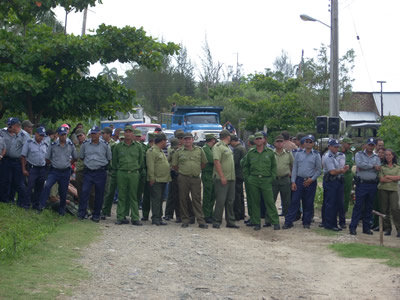

These pictures were taken with a mobile phone on 1 August, brought to La Habana by Reina Luisa and later distributed by Cuban blogger Yoani Sanchez.
Dear Sir or Madam:
Every Sunday, we receive, mostly through phone interviews broadcast by the US-based Radio Martí, the same report from Reina Luisa describing how she is beaten, insulted and how [the government directed mob] prevents her from going to the town’s church to pray for her son and the health of all Cuban political prisoners still in jail. The repressive organs of the Cuban regime also impede her to visit her son’s tomb.
It is surprising to us that despite the wide coverage dedicated to Cuban topics, your organization has not reported on this. We know of the limitations to movement within Cuba, but we also understand that any foreign reporter has the means and resources to travel to the Eastern part of the island and give an eyewitness report of what happens there, in front of Reina Luisa Tamayo’s home.
We do not wish to tell the media what they should do, but to share with you our concern for the life of a woman who has lost her son in unjust circumstances and is clamoring for the world’s help to avoid more deaths.
We, the promoters of the #OZT: I accuse the Cuban government Campaign that demands the unconditional and immediate release of all peaceful political prisoners in Cuba and the respect of all Cubans’ human rights; write to you because we know that the international press in Cuba not only bears witness to what happens there, but can also help prevent and stop harassment incidents like those suffered by the Ladies in White in March of this year.
We would also like to know if there is any kind of legal hindrance or of any other sort that prevents your reporter in La Habana from traveling to other regions of Cuba.
We thank you in advance for your reply.
Sincerely,
#OZT: I accuse the Cuban government Campaign
Human Rights Cuba reports:
On the 16th anniversary of the Maleconazo, a large scale protest that took place in Havana in 1994 due to public discontent over food shortages and energy blackouts, Cuba’s repressive forces conducted a massive arrest of human rights activists and independent journalists.
The arrested were detained, beaten, interrogated and later released. This took place yesterday near the U.S. Interests Section building on Cuba’s waterfront known as the Malecon. Among the arrested were human rights activists who wanted to peacefully mark the anniversary and independent journalists who were trying to enter the building to use the internet on their scheduled appointment day and time.
Those arrested were:
- Alfredo Guilleuma “El Viejo Alfredo”, an elderly Human Rights Activist
- Carmelo Rodríguez Rodríguez, Human Rights Activist and member of the Movimiento Línea Dura “Orlando Zapata Tamayo”
- Daniel Anselmo Gonzalez, Independent Journalist and Vice President of the Comision for Assistance to Political Prisoners and their Families (CAPPF)
- Ernesto Rodríguez López, Human Rights Activist
- Enrique Labrada, Human Rights Activist
- Hector Julio Cesar Cedeño, Blogger and Independent Journalist
- Heriberto Liranza Romero, Human Rights Activist and member of the Movimiento Cubano de Jóvenes por la Democracia
- Hermogenes Inocencio Guerrero, Human Rights Activist and Vice President of Naturpaz
- Hidelbrando Chaviano, Blogger and Independent Journalist
- Hugo Damian Prieto Blanco, President of the Movimiento Línea Dura “Orlando Zapata Tamayo”
- Joel Lázaro Carbonell, Blogger and Independent Journalist and President of the Organización de Derechos Humanos Cubanos Libres
- Jose Alberto Alvarez Bravo, Blogger and Independent Journalist
- Juan Carlos Basallo Fregio, Human Rights Activist and member of the Partido Liberal de la República de Cuba
- Juan Mario Rodríguez, Human Rights Activist
- Julio Antonio Rojas Portal, Blogger and Independent Journalist
- Omar Lafita Rojas, Independent Journalist and Attorney
- Roby Gonzalez Torres, Independent Journalist and member of the Comision for Assistance to Political Prisoners and their Families (CAPPF)
- Ruben Carty Lowe, Blogger and Independent Journalist who is the Director of Centro Informativo Cubano
- Silvio Benítez Márquez, Independent Journalist and President of the Partido Liberal de la República de Cuba
Other activists were also detained and arrested whose names were not available at the time this information was reported.
(H/T Marc Masferrer)
Video from Al-Jazeera:

This has been my favorite emblem, starting one day when I believed to have found images alone lacking. Many things have happened since, and I was suspicious of images and had understood, as the creator of that emblem, I think understood that only through the union of image and text could there be a construct that spelled out a truth and included a picture.
One day, Orlando Zapata dies. I search for his image, and found it, but it is a photograph of very poor quality. Therefore, although I had an idea of what his face looked like, it was always in an abstract, blurry manner. This photographic document is also an identification one. The photo seems to have been taken from a [Cuban] identification booklet. I felt crushed when I realized this because this image is not a memory. It is simply an instrument of control, a way to be identified, but by the police.
Apparently, Orlando did not have many photographs. There are two others on the internet, but they are also of low resolution. Paradoxically, it is this image, the one taken to excise control over him, that in some way has become an emblem of his liberty, or more accurately, of Liberty.
Later, I decided to create “Némesis”, a performance piece that consists of projecting that very same photograph on the facades of buildings that shelter representatives of the [Cuban] dictatorship. One of the difficulties I found during the performance was precisely the bad quality of the image, mostly to project it from a certain distance and still keep Zapata’s face recognizable. I think that in some way, and not without some difficulty, this was finally achieved.
A few days ago, (still unsatisfied with this image) I decided to use it as a model, and try to paint a portrait. It was not an easy task because it lacks detail, volume, etc. I had to imagine many things about this face. Today, I have finished the emblem: the portrait is the image; Orlando Zapata is its text.
All who so wish can use this image-emblem. It is my gift to all who desire Liberty for Cuba.
Geandy Pavón
About the food they were given daily for seven years:
A hairy heap of ground pig eyes, cheek, ears, and other unidentifiable parts served as a main course.The cells in which they were kept:
The meal, nicknamed patipanza, is one of the typical dishes served in Cuban prisons, according to political prisoners freed and expatriated to the Spanish capital under an agreement negotiated by the Roman Catholic Church and the Spanish government.
"They didn't even bother to take the hairs off the animal's skin and it stank," says Mijail Bárzaga, 43, who spent seven years in four Cuban prisons.
In the Havana prison El Pitirre, where he spent two years, the food was more edible than in the others, Bárzaga said, but the portions of rice, watery picadillo and pea stew served to the prisoners kept getting smaller and smaller.
"The guards would steal from our portions, they would steal from the prison ministry to feed their families and to sell in the black market," Bárzaga said. "To steal from a man in prison who can't do anything about getting himself nourishment is denigrating -- the lowest point of humanity."
Often there was dirt at the bottom of the boiled concoctions. Other times, worms and bugs in the food.
"Kafka couldn't have written it worse," said Ricardo González Alfonso, an independent journalist sentenced to 20 years after his arrest in the Black Spring of 2003.
Small prison cells became filthy with overflowing feces. Rats, cockroaches and scorpions shared their jail cells, Julio César Gálvez said.On coexisting with common prisoners:
Just when the prisoners and their families adjusted to a prison, they were transferred.
"I was constantly moved from prison to prison and my family couldn't visit me," said José Luis García Paneque, a plastic surgeon who was a burly, 190-pound man when he was sent to prison and now weighs 101 pounds.
Paneque takes a reporter's notebook and drew a sketch of one of his prison cells -- a hole on the floor that served as toilet and shower, a sink with a spigot turned on only a few minutes a day, a metal bed with a thin foam mattress.
"The cells are all the same -- tiny, windowless," he said.
The solitary cells, used for punishment, were even worse.
Being among criminals posed a threat, but the political prisoners said they earned their respect by explaining to them why they were in prison.Human horror:
"We gave them a political education and they were helpful to us," Bárzaga said.
When he first arrived in a Villa Clara prison, he added, there were no utensils available. The presos comunes -- those in prison for common, rather, than political, crimes -- made him a spoon from a can and a cup from a cut-up water bottle.
Some of the common prisoners helped the political ones smuggle out letters and documents denouncing conditions
The political prisoners also witnessed how common prisoners resorted to drastic measures, making themselves ill -- setting fires to their mattresses and wrapping themselves in them, cutting their eyeballs -- to get a guard's attention to be sent to the infirmary.Read it all, share it, spread the word, and help us fight for the freedom of all remaining Cuban political prisoners, and for the respect of human rights and dignity in the archipelago.
"I saw a prisoner inject excrement in his veins. Nobody told me this, I saw it with my own eyes,'' said Omar M. Ruiz Hernández. "They sewed their mouths with wire. They do all this to protest the conditions, to get something they've been denied."
Jorge Castañeda: "Fariñas [...] achieved what no one has done before."
posted on Friday, July 30, 2010The Miami Herald reproduces this The New York Times article by former Mexican Minister of Foreign Affairs Jorge Castañeda regarding the latest political developments in Cuba:
The Castros blink
BY JORGE G. CASTANEDA
jorgecastaneda.org
Finally, someone in Cuba went eyeball to eyeball with the Castro brothers, and they blinked.
On July 7, Guillermo Fariñas, a dissident on a hunger strike for more than four months, achieved what no one has done before. Through a combination of careful confrontation, personal fortitude and international support, Fariñas forced Raúl Castro to negotiate with Cuba's Roman Catholic Church -- which led to the immediate release of five political prisoners, with 47 more to follow over the next four months.
Of course, this is not the first time that the Cuban regime has freed political prisoners. The many other instances were almost always in exchange for political and economic concessions.
In 1978, Fidel Castro allowed more than 3,000 jailed dissidents to leave for the United States after a group of exiled Cubans from Miami visited Havana. Many in the Miami group subsequently advocated for ending the U.S. embargo against Cuba.
In 1984, Castro freed 26 prisoners; in 1996, three; and in 1998, more than 80, after visits from, respectively, Jesse Jackson, Bill Richardson and Pope John Paul II, according to The Miami Herald's Andres Oppenheimer.
Spain's Foreign Minister Miguel Angel Moratinos desperately tried to play a role in the Fariñas case. But this time, the circumstances were different. Fariñas was willing to die for his demands; he saw how they were, in a sense, reinforced by the death of another hunger striker, Orlando Zapata, last February.
The Castros knew that Fariñas would die, too, if they didn't accept his demands, and that his death would make any improvement in relations with the European Union or President Obama even more difficult to acheive.
The island's economic situation has gone from dire to worse in recent times. Raúl Castro recognized that, without a rapprochement, he couldn't achieve whatever changes he might hope to make -- hence the dialogue with the church and the release of the prisoners.
Despite Fariñas' courage and political skill, the significance of the agreement between Cuba's Cardinal Jaime Ortega and Raúl Castro is modest.
• First, circumstances may change during the four months that will pass before all the prisoners on the list are freed. Meanwhile, the remaining prisoners are still hostage to the Castros' dealings with the church and possibly the European Union.
• Second, an additional 100 political prisoners in Cuba, and perhaps many more, are not included in the agreement. [The government has since indicated it may free all political prisoners, but that has not been confirmed.]
• Third, articles 72 and 73 of the Cuban criminal code, which establish the notion of ``dangerousness'' -- an outrageously inexplicit word that has been denounced by Human Rights Watch -- are still on the books.
According to Cuban law, anybody can be jailed at any time, even before committing a crime, if they are perceived to have a penchant for doing so. And political opposition to the regime is a crime.
• Finally, it is unclear whether the 52 dissidents will be freed in Cuba or deported to Spain and elsewhere. Fidel Castro has used expulsion from his homeland as a political instrument for more than half a century, with great success.
Whether the church and Spain should lend themselves to this ploy is debatable. Even ``voluntary'' exile is a non sequitur: Asking political prisoners in poor health to sign a statement that they will willingly accept exile is hardly magnanimous or ethical.
Most important, however, is whether small gestures like the new agreement alter the human-rights situation in Cuba and represent the beginning of a transition in Cuban politics.
Jose Miguel Vivanco, the Americas director of Human Rights Watch, hit the mark when he said that he could not congratulate a government for freeing people who should never have been jailed.
The real issue is whether there is any justification for the survival of a regime that acknowledges the existence of political prisoners, uses them as bargaining chips and needs to be forced by dead or dying hunger strikers to liberate any of them. Little can be done to change this situation until the Cuban people decide they have had enough. Meanwhile, voters should question their leaders' having any dealings with the Cuban regime.
Cuban blogger Claudia Cadelo, informs through Twitter that Guillermo Fariñas has been discharged from hospital, and is at home.
There were no details on his current condition, but we will update the post as soon we obtain further them.
UPDATE: Italian news agency ANSA informs in Spanish details his discharge from hospital. It states that Fariñas will have to use a wheelchair due to a neuropathy caused by his 135 day long hunger strike (his 23rd) and that he still suffers from a clot in one of his carotids that will take years to treat.
The opposition activist told the reporter that because of his motor limitations, he will continue his work as an independent journalist from his home.
We are happy to see Fariñas out of hospital, albeit not completely healthy. We will monitor his situation, and wish him a speedy recovery. And, we are most grateful to this great Cuban for his fearless fight, for risking his own life for the release of Cuban political prisoners.
Cuban consulate in Seville, Spain, receives the more than 52,000 signatures for freedom
posted on Wednesday, July 28, 2010A group led by Ana Fuentes, member of this campaign’s organizing team, has successfully delivered the more than 52,000 signatures supporting our Declaration for the Freedom if Cuban Political Prisoners at the Cuban consulate in Seville, Spain. This is the first successful delivery after we announced the start of such deliveries. Other similar efforts have been met with rejection and resistance (in one case, physcally violent) by the regime’s representatives in La Habana, Madrid, Barcelona, Montréal and New York.
In Seville, it was possible to deliver the signatures to a Spanish administrative employee at the consulate. The Cuban diplomats refused to come out to receive them, but told the Spaniard to accept them.
In the group there were several Cubans, and among them was Eddie Fernández a participant of Pedro Pan Operation, as well as several Sevilleans, including a lady representing the Asociación de Víctimas del Terrorismo [Association of Victims of Terrorism].
A reporter for the local El Correo newspaper was also present.
The newspaper reports on his statements to the press before departing La Habana:
"I'm going, looking to regain my health," he told reporters at the Havana airport before boarding his flight. "When I arrive in Miami . . . they are waiting for me and will take me to Jackson Memorial Hospital, where I hope to regain my strength."
Sigler said he eventually planned to return to Cuba "because this government's days are numbered."
"This dictatorship has very little time left," he said, "and I think this will be a temporary departure."

Dr. Darsi Ferrer: " It is very sad to see a country’s youth behind bars, living in cruel and deforming conditions, surviving as non-persons."
posted on Wednesday, July 28, 2010
Marc Masferrer reproduces some fragments of an interview with Dr. Darsi Ferrer by Cuban independent journalist Juan Carlos González Leiva originally published on Payo Libre.
This is our translation:
Juan Carlos González Leiva: How is the health of Darsi Ferrer?
Dr. Darsi: First, I would like to say that I am very happy with your visit. One comes out of prison affected [by psychological issues] but I am in better spirits.
JC: According to [the regime’s] accusations [against you], you should have received a 3 year sentence. To what do you attribute your premature release?
Dr. Darsi: Many factors contributed to, and resulted in my release. In first place, [there was the] recognition of my status as a prisoner of conscience by that prestigious institution, Amnesty International, for what I will be eternally grateful. Also, [there was] the immense solidarity from the international black movement, and, of course, the solidarity of my Cuban brothers, here and in exile.
JC: What does Valle Grande prison represent to you?
Dr Darsi: This is a prison for those who are in preventive custody [not tried yet], [but] despite that it does not differ from [all] other Cuban penitentiaries. Life conditions are totally subhuman and the penal population suffers the cruelest and most inhumane treatments. For example, medical attention is almost [non-existent] because in spite of having doctors on staff, [in reality] they do not exist, neither is there equipment to perform a hemoglobin or glycemic test. Everything is a [smoke] screen [and] that is why there are inevitable deaths. Only in the past 11 months, three inmates died there for that reason. Overcrowding is terrible in the 18 galleys. They are 35 meters long by 5 meters wide, [and] there 120 inmates survive with only half a meter of vital space for each one of them. Many of them have to sleep on the floor because there are not enough beds.
Hygiene is horrible, they only run the water for a few minutes three times a day, every other day, and the heat is unbearable. Infectious diseases are very frequent, it is enough that one inmate gets sick [for the rest to be infected]. Contact with the family is limited to two hours once a month. The psychological trauma is very big. The scarce nourishment is of terrible quality and does not satisfy the needs of any human organism. As protein, they give you a tiny piece of chicken every 15 days. The rest of the food is a [disgusting mix] that is regularly [given to the prisoners] in state of decomposition. This brings lots of diseases and health problems.
The mistreatment and the horrible conditions make the inmates aggressive. There are frequent fights. Corruption is rampant. The guards are more criminals than the inmates are, and they have several inmates in their fold who control all their illicit businesses for their own personal benefit, and the most lethal are used to impose discipline. The guards are the ones that facilitate the sale of rum and the high drug use. Religious assistance and freedom of worship are not allowed. There are several disabled [inmates] [whose conditions] are incompatible with the prison system. I met blind, deaf and some in wheelchairs. In the political prisoners’ case, they survive in constant danger since the guards constantly encourage assassins to harass them and attack them. It is Hell, a nightmare that if you do not experience it, you cannot imagine how horrible the Cuban jail system is.
JC: Could it be said that Cuban jails are centers of terror?
Dr. Darsi: Prisons here make up such a gruesome picture that words cannot describe it in all of its magnitude. This is the reason why the government does not allow monitoring by the [UN’s] Rapporteur Against Torture, His Excellency Manfred Nowak. [They] have much to hide. The UN Standard Minimum Rules for the Treatment of Prisoners are not respected at all, and even national laws are violated daily in there.
JC: What is the number of prisoners inside Valle Grande prison right now?
Dr. Darsi: There are 18 galleys with a total penal population around 2000 inmates. It must be noted that, as I said, this is a prison for [those] awaiting trial, and it is the only one that receives those who are under [arrest awaiting trial] in all of the [province of] Ciudad de La Habana. Almost every day, around 80 to 100 new inmates are admitted, which is incredible. Of course, this does not include those already sentenced who are sent directly to other penitentiaries. In other words, the number of Cubans who are sent to prison daily is alarming. That is why I can assure [anyone] that the Cuban penal population is not 100,000 inmates as it has been said until now, but that it is well above 200,000 convicts. It is such an amazing [uncontrolled growth] that it forces the government to hide it.
JC: Could it then be stated that more than 500 people are incarcerated each week only in La Habana?
Dr. Darsi: I do not say 500 people, but a much higher number because one has to take into account the prisons for women that are 4 or 5; the juvenile prisons, and the uncountable penitentiaries in the city and province of La Habana. The Combinado del Este prison alone keeps around 5000 inmates behind bars. These are the reasons why I call on all people and institutions around the world to make an even greater effort to help humanize the Cuban jail system, alleviating the suffering of hundreds of thousands of convicts and their families.
JC: What are the race and age characteristics of the penal population at Valle Grande?
Dr. Darsi: Around 80% are black and more than 70% of the total is not over the age of 25. It is very sad to see a country’s youth behind bars, living in cruel and deforming conditions, surviving as non-persons.
JC: Marxism books state that criminality is a leftover from capitalism; however, Cuban convicts are in their vast majority young and black, born after the revolution. How can this be explained?
Dr. Darsi: The lack of opportunities, the arbitrariness, the injustices…I would say that they [affect] all the same. What happens is that for cultural and economic reasons, blacks were behind [everyone else] when the revolution triumphed, in other words, blacks were behind, and blacks were left much further behind later. Today are blacks the one who live in “solares” [tenements], those who are barred from hotels and those who are not [represented] in the [highest] political [levels]. It is enough to say that in a country where surviving is hard for everyone, those issues are tenfold for blacks. All of this forces blacks to be linked to issues like the black market. They go beyond what is tolerated by the authorities and remain in [extreme poverty] being much more alienated, discriminated against and displaced than whites. This is a grave problem because this is not a [mainly] Caucasian society. Cuba is a country where he who does not have Congo [blood] has [that] of Carabalis. We are a racial “ajiaco” [stew], despite the government’s efforts to reinforce the idea that black is negative. This is why blacks in prison receive the worst treatment and contempt from the guards. I can conclude by stating that blacks have been thrown by the so-called revolution into the lowest sectors of [Cuban] public life.
JC: What is the explanation for the use of drugs and alcohol at Valle Grande?
Dr. Darsi: The average salary of the guards is extremely low. They live in misery as well, that is why most of the practice corruption. Inside of the prisons, corruption is huge. It is precisely the guards who own this business of alcohol and prescription drugs sales. It is they who bring those noxious substances to the penitentiaries around the country. It is incredible and scandalous, but tremendously real. These are the direct causes of the frequent fights and murders. Furthermore, under the influence of alcohol and drugs, the inmates mutilate themselves or inject [themselves with the] AIDS [virus] with syringes supplied by the guards. One day, I saw the guards bringing six AIDS patients into my galley and left them to live with us. Some had bleeding wound since they had hurt themselves. Logically we were all [exposed] to the risk [of infection].
JC: What treatment receive those who are physically and mentally disabled at Valle Grande?
Dr. Darsi: They are victims of the worst treatments because since they are sick, they do things that irritate the guards.
JC: How would you describe your trial?
Dr. Darsi: I was tried behind closed doors by the Municipal Tribunal of Diez de Octubre [a municipality in La Habana] this past 22 June, and sentenced to 1 year and 3 months of prison. [During the trial] Security of State cordoned off the area [surrounding the tribunal] and subjected me to a biased process, lacking any [due process]. They tried me 11 months after my arrest, and they sentenced me after I had already served the time, on the trumped up charges of “Sabotage and receipt [of stolen merchandise]” that implies that I must serve another three months in this sort of house arrest. I do not accept this condition, and I am ready to be sent back to prison whenever the political police would want because I am innocent and my trial was nothing but a circus. My family, friends and neighbors could attend.
JC: Do you continue to have the same dreams?
Dr. Darsi: Cuba continues to be a large jail, and our people still lives the same drama of the destruction of all their freedoms and rights. This is what motivates me to continue fighting for democracy and [the rule of law]. I am 40 years old, and I do not know freedom. I move forward with even more emphasis so that soon Cuba becomes a place of happiness, prosperity and opportunities for all.
As we informed last week, Ariel Sigler Amaya arrives in Miami tomorrow (today) 28 July 2010.
A humanitarian fund account has been set-up for him at BB&T Bank of Miami to help with his healthcare costs.
Ariel Sigler -Humanitarian Fund
Acct # 0000148280827


