
Ros-Lehtinen Condemns Cuban Dictatorship's Cowardly Attacks On Reina Luisa Tamayo
posted on Tuesday, August 17, 2010Washington, DC – Congresswoman Ileana Ros-Lehtinen, a senior member of the Florida Congressional Delegation, issued the following statement after hearing an audio tape of Sunday’s attack on Reina Luisa Tamayo, mother of deceased political prisoner Orlando Zapata Tamayo, who died at the hands of the Castro regime. For the last couple of Sundays, Reina Luisa Tamayo has been verbally and physically attacked by state sponsored mobs as she tries to visit a local church to pay respects to her deceased son in her hometown of Banes, Holguin.
Ros-Lehtinen’s statement:
“The cowardly, brutal, dying and fearful dictatorship of the Castro brothers once again stoops to its usual low. Their latest attacks on Reina Luisa Tamayo, preventing this infirmed 62 year old grieving mother from attending Sunday church, is yet another example of the ruthlessness of the Castro regime.
A mob of hundreds of state sponsored thugs surrounded Reina’s home in Banes this past Sunday morning screaming vulgar and racial slurs against her and the five women and one girl who tried in vain to attend church. This grieving mother is even prevented from visiting her son’s remains in the town cemetery because the regime fears any possible outpouring of support for Cuban patriot Orlando Zapata Tamayo, who died while imprisoned in Castro’s jails.
Only in a failed state such as communist Cuba would the regime send State Security and Interior Ministry forces to keep a grieving mother from properly mourning the death of her son. The international community must come to terms with the sad fact that the latest ploy by the regime of releasing political prisoners is just that, a ploy. Nothing has changed in Cuba and nothing will change as long as the Castro brothers and their feared and repressive apparatus are in control. Anyone who has any doubt need only hear or see the images from Reina’s home this past Sunday morning.”
***
PRESS RELEASE
For more information: August 16, 2010
Alex Cruz, Communications Director
Office 305-668-5994 or 202-225-3931
Cellular 202-225-8200 or 202-225-4630
Amnesty International calls for urgent action to protect Reina Luisa Tamayo
posted on Thursday, August 12, 2010URGENT ACTION
MOTHER HARASSED FOR MARCHING FOR DEAD SON
The mother of a Cuban prisoner of conscience who died after hunger striking has been repeatedly harassed and intimidated in an attempt to stop her from organizing marches to commemorate her son's death. The next march is planned for 15 August.
Reina Luisa Tamayo is the mother of Orlando Zapata Tamayo, a prisoner of conscience who died on 22 February 2010, having spent several weeks on hunger strike whilst in prison. Since her son’s death, Reina Luisa Tamayo has organized weekly marches on Sundays in the town of Barnes, Holguin Province, Cuba, to honour her son's memory.
Relatives and friends accompany Reina Luisa Tamayo on these weekly marches from her home to attend mass at the Nuestra Señora de la Caridad Church, in Barnes and from there to the cemetery where Orlando Zapata Tamayo is buried. Last Sunday, 8 August, the group reported that as soon as they tried to leave Reina Luisa Tamayo’s house to start their march, they were confronted a few metres away from the house by hundreds of government supporters who blocked their way and beat some of the participants. They were pushed back to the house and followed into the house’s garden. The participants tried twice more to leave the house and resume the march but they were again violently confronted by the government supporters, who stayed outside the house until late in the afternoon. According to Reina Luisa Tamayo, during all this time a police patrol was close to her house watching as the events unfolded and failing to intervene.
The group have reported how prior to 8 August, they have also been confronted by government supporters and state security officials who have gathered around Reina Luisa Tamayo's house and prevented them from marching, sometimes preventing them from reaching the church, the cemetery, or both. They have also reported how state security officials and police officers have set up check points on the routes to Reina Luisa Tamayo’s house on the day prior to the march to prevent people from reaching the house and joining the march.
PLEASE WRITE IMMEDIATELY in Spanish or your own language:
Calling on the authorities to ensure an immediate halt to the harassment and intimidation of Reina Luisa Tamayo by government supporters, and that of her relatives and friends and any other citizens who seek to peacefully exercise their right to freedom of expression, assembly and association;
Calling on the authorities to permit Reina Luisa Tamayo and others to march peacefully as is their right on Sundays.
PLEASE SEND APPEALS BEFORE 22 SEPTEMBER 2010 TO:
Head of State and Government
Raúl Castro Ruz Presidente
La Habana, Cuba
Fax: +53 7 8333085 (via Foreign Ministry); +1 2127791697 (via Cuban Mission to UN)
Email: cuba@un.int (c/o Cuban Mission to UN)
Salutation: Su Excelencia/Your Excellency
Interior Minister
General Abelardo Coloma Ibarra
Ministro del Interior y Prisiones
Ministerio del Interior, Plaza de la Revolución, La Habana, Cuba
Fax: +53 7 8333085 (via Ministry of Foreign Affairs)
+1 2127791697 (via Cuban Mission to UN)
Salutation: Su Excelencia/Your Excellency
Also send copies to diplomatic representatives accredited to your country. Check with your section office if sending appeals after the above date.
URGENT ACTION
MOTHER HARASSED FOR MARCHING FOR DEAD SON
Additional Information
Reina Luisa Tamayo is one of the Damas de Blanco (Ladies in White), a group of women relatives and friends of prisoners detained during a major crackdown on government critics in March 2003. In 2003, over several days, the Cuban authorities arrested 75 men and women for their peaceful expression of critical opinions of the government. They were subjected to summary trials and were sentenced to long prison terms of up to 28 years. Amnesty International declared the 75 convicted dissidents to be prisoners of conscience, 32 of them remain in prison.
Damas de Blanco organizes peaceful weekly marches in Havana where they distribute flowers and call for the release of their relatives and friends. In March 2010 Damas de Blanco organized a daily march for a week to mark the seventh anniversary of the arrest of their relatives. On 17 of March 2010, their march was forcibly broken up by Cuban police, who briefly detained several women. Some of the women claimed that they were beaten by the police.
UA: 174/10 Index: AMR 25/012/2010 Issue Date: 11 August 2010
(Source: Amnesty International).
Castro forces dissidents to accept exile as the price of release from his dungeons.
The announcement last month that Cuba would exile 52 political prisoners currently in jail was supposed to help repair the regime’s international image in the wake of the death of Orlando Zapata.
It’s not working. The 21 who have already arrived in Spain are speaking out about the hell hole run by Castro that is Cuba. And at least 10 are refusing to leave the country. Zapata lives.
In December 2009, Zapata, who had been rotting in a rat-infested prison cell and repeatedly tortured for almost seven years, launched a hunger strike on behalf of Cuba’s prisoners of conscience. He was protesting the unjust incarceration of nonviolent dissidents and the cruelty inside the dungeons. The regime desperately tried to break him, even refusing him water for a time. This led to kidney failure and his death on Feb. 23.
Zapata’s passing sparked international outrage, and on July 7 the regime yielded to the pressure. It agreed to release the independent journalists, writers and democracy advocates who had been jailed during the 2003 crackdown on dissent, known as the Black Spring.
Yet only the naïve could read Castro’s forced acquiescence as a break with tyranny. It is instead a cynical ploy to clean the face of a dictatorship. It is also an effort to reclaim respectability for the world’s pro-Castro politicians, including Spanish Foreign Minister Miguel Ángel Moratinos. No one understands this better than the former prisoners.
Those sent to Spain have not hidden their joy about getting out of Cuban jails. “There are no words to fairly describe how amazed and excited I was when I saw myself free and next to my wife and daughter again,” Normando Hernández González told the Committee to Protect Journalists in a telephone interview. But Mr. Hernández, an independent journalist, hasn’t minced words about Cuban repression either.
In a telephone interview with Miami’s Radio Republica, he talked about his “indescribable” time in jail. “It’s crime upon crime, the deep hatred of the Castro regime toward everyone who peacefully dissents. It is a unique life experience that I do not wish upon my worst enemy.”
The regime tried to spruce up the former prisoners by dressing them in neatly pressed trousers, white shirts and ties. But they brought tales of horror to Spain. Ariel Sigler, a labor organizer who went into prison seven years ago a healthy man but is now confined to a wheel chair, arrived in Miami on Wednesday.
These graphic reminders of Castro’s twisted mind have been bad for Mr. Moratinos’s wider agenda, which is to use the release of the prisoners to convince the European Union to abandon its “common position” on Cuba. Adopted in 1996, it says that the EU seeks “in its relations with Cuba” to “encourage a process of transition to pluralist democracy and respect for human rights and fundamental freedoms, as well as a sustainable recovery and improvement in the living standards of the Cuban people.” Mr. Moratinos’s desire to help Fidel end the common position is a source of anger among Cuban dissidents.
The former prisoners also resent their exile, after, as Mr. Hernández puts it, “being kidnapped for seven years.” He explained to Radio Republica: “The more logical outcome would be, ‘Yes, you are freeing me. Free me to my home. Free me so I won’t be apart from my sister, from my family, from my people, from my neighbors.’” Instead he says he was “practically forced” to go to Spain in exchange for getting out of jail, and to get health care for his daughter and himself.
Cuba’s horrendous prison conditions are no secret. In his chilling memoir “Against All Hope” (1986, 2001), Armando Valladares cataloged the brutality he experienced first hand as a prisoner of conscience for 22 years. A steady stream of exiles have echoed his claims. But another bit of cruelty is less well understood: For a half century the regime has let political prisoners out of jail only if they sign a paper saying they have been “rehabilitated” or, when the regime is under pressure, if they agree to leave the island. Getting rid of the strong-willed, while being patted on the back for their “release,” has been Castro’s win-win.
Now some prisoners are refusing to deal. Ten of the 52, including Óscar Elías Biscet, famous for his pacifism, say they will not accept exile as a condition of release. These brave souls remain locked up.
Of course, if they are released and allowed to stay home, the same “crimes” that landed them in prison are likely to do so again. A particular hazard for dissidents is Article 72 of the Orwellian Cuban criminal code, which says that “any person shall be deemed dangerous” if he has “shown a proclivity to commit crimes demonstrated by conduct that is in manifest contradiction with the norms of socialist morality.”
Cuban dissidents claim there are hundreds and perhaps thousands of prisoners locked up for “dangerousness,” “contempt” and other crimes of dissent. No one knows for sure. But shipping a few dozen out of the country doesn’t qualify as a step toward civilized government. The memory of Zapata demands much more.
Mary Anastasia O'Grady, The Wall Street Journal
H/T: Penúltimos Días
Cuban-born artist Geandy Pavón has taken his art-protest “Némesis” to Madrid. The performance consists of digitally projecting onto the façade of buildings the image of Cuban political prisoner Orlando Zapata Tamayo, who recently succumbed to a hunger strike.
In Greek mythology, “Némesis” represents divine justice─a persecutory memory. With this creation, Pavón “imposes the face of the victim upon the assassin, using light as an analogy of truth, reason, and justice.”
The performance has been made in New York, Washinton, and Barcelona before. At this time, Pavón dedicated the event "To the memory of Olga Guillot, and all the Cubans who died in the hope of seeing a free Cuba".
Raul Castro Government Continues to Criminalize Dissent
July 8, 2010
(Washington, DC) - The plan to release a group of Cuban political prisoners is a positive step, but the Cuban government should release all political prisoners, Human Rights Watch said today. Cuba should also dismantle its authoritarian laws and practices, which continue to deprive Cubans of their most basic rights, Human Rights Watch said.
The Catholic Archdiocese of Havana announced on July 7, 2010, that the Cuban government would release five political prisoners on the condition that they relocate to Spain with their families, and that an additional 47 political prisoners arrested in 2003 would be released in three to four months.
"While we are relieved for these prisoners and their families, the fact remains that scores of political prisoners locked up under Raul Castro continue to languish in Cuba's prisons," said José Miguel Vivanco, Americas director at Human Rights Watch. "So long as Cuba's draconian laws and sham trials remain in place, they will continue to restock the prison cells with new generations of innocent Cubans who dare to exercise their basic rights."
The political prisoners expected to be released are among 75 journalists, human rights defenders, labor activists, and other peaceful dissidents arrested in a massive crackdown by the Cuban government in March 2003. All 75 were tried in closed, summary trials that violated their most basic due process rights, and sentenced to an average of 19 years in prison.
Since taking over control of the government from Fidel Castro in July 2006, Raul Castro has incarcerated scores of political prisoners. The government has relied largely on a provision of the Criminal Code that allows authorities to imprison individuals without ever having committed a crime, on the allegation that they are "dangerous" and might commit one in the future. A recent Human Rights Watch report, "New Castro, Same Cuba," documented more than 40 cases of dissidents who have been imprisoned for "dangerousness" under the Raul Castro government, in addition to scores more sentenced for laws criminalizing free expression and association.
The Cuban Commission for Human Rights and National Reconciliation (CCDHRN), a respected human rights group that is not recognized by the Cuban government, has been able to document 167 cases of current political prisoners. Because Human Rights Watch has been able to document additional cases of people imprisoned for "dangerousness," Human Rights Watch believes the number of political prisoners is even higher.
Previous efforts by religious, civil, and political leaders to negotiate with the Cuban government have led to the release of some political prisoners. Reverend Jesse Jackson convinced Fidel Castro to release 26 political prisoners in 1984, and Human Rights Watch's Vivanco secured the release of six in 1995. Talks with Bill Richardson led to the release of three dissidents in 1996, and Jimmy Carter's 2002 visit prompted the release of one more. The visit of Pope John Paul II in 1998, after which more than 80 jailed dissidents were released, was the most successful of these efforts.
"The international community needs to pressure Cuba to go beyond the periodic release of jailed dissidents and instead dismantle the repressive laws, courts, and security forces that put them in prison in the first place," Vivanco said.
In the past, the Cuban government has released political prisoners on parole (licencia extrapenal) rather than releasing them unconditionally. By granting them parole only, the Cuban government leaves open the possibility of returning dissidents to prison to serve out their sentences in the future, intimidating them to keep them from exercising their fundamental rights.
Furthermore, in recent instances such as the February 2008 release of four political prisoners, the Cuban government has forced dissidents to choose between staying in prison and being exiled to Spain, which fundamentally violates their rights as Cuban citizens. Public statements of those involved in the negotiations for the planned releases suggest that the first five prisoners to be released were presented with a similar choice. Human Rights Watch recommend that all prisoners, including those from the group of 75, be released unconditionally and be allowed to stay in Cuba with their families.
The announcement of the prisoners' upcoming release came in the context of the 134-day hunger strike of the Cuban journalist Guillermo Fariñas, who was calling for the release of 26 political prisoners suffering from severe health problems. Fariñas began his hunger strike on February 24, the day after a political prisoner, Orlando Zapata Tamayo, died following his own 85-day hunger strike. Fariñas reportedly ended his hunger strike on July 8, following the announcement of the release.
Efforts by the US government to press for change in Cuba by imposing a sweeping embargo have proven to be a costly and misguided failure, Human Rights Watch said. The embargo has inflicted severe hardship on the Cuban population as a whole, while doing nothing to improve the human rights situation in Cuba. Rather than isolating Cuba, the policy has isolated the United States, alienating Washington's potential allies on this issue.
MADRID, Spain (AFP) — Spanish Foreign Minister Miguel Angel Moratinos said on Thursday he would visit Cuba next week to speak about human rights and support mediation efforts launched by the Roman Catholic Church.
“I will be visiting Cuba Monday and Tuesday,” he told Cadena Ser radio, adding that the aim was to “pursue every effort at dialogue to improve the human rights situation and the process of reform” on the communist-ruled island.
Moratinos singled out the recent successes of the Church with regard to political prisoners, saying, “I am convinced there will be positive results with regard to human rights” in Cuba.
Last month Havana released an ailing political prisoner, Ariel Sigler, and transferred 12 other detainees to facilities in their home provinces following unprecedented dialogue between Cuban President Raul Castro and Roman Catholic Cardinal Jaime Ortega.
Shortly afterwards Vatican Foreign Minister Dominique Mamberti described evolving relations between Roman Catholic Church and Cuba as “very positive,” on a visit commemorating the 75th anniversary of ties.
Jailed dissident physician Darsi Ferrer was also released in June after serving 11 months of a 15-month jail sentence for illegally purchasing construction materials — charges his family said were trumped up.
Imprisoned several times for heading protest movements, Ferrer in April went on a three-week hunger strike to demand a fair trial and medical attention. His cause was taken up by several Western nations.
Moratinos said that another dissident, Guillermo Farinas, was in a serious condition after launching a hunger strike four months ago to secure the release of 26 sick detainees.
Farinas stopped taking food the day after leading dissident Orlando Zapata died on February 23 as the result of an 85-day hunger strike.
The Cuban Human Rights and National Reconciliation Commission (CCDHRN) — an outlawed but tolerated group — estimates there are some 200 political prisoners in the Caribbean nation of more than 11 million people.
Cuban authorities consider them a threat to national security, and claim the prisoners are “mercenaries” on Washington’s pay, out to smear the Cuban government.
During its just-ended tenure of the European Union’s rotating presidency, Spain urged that full relations with Cuba be restored, but it met with resistance from other countries in the 27-nation bloc.
EU foreign ministers decided to look at the question again in September.
The “common position” at present is to insist that Cuba make progress on human rights and democracy before ties are normalized, diplomats said.
Spain has argued that the EU position has yielded few results since it was adopted in 1996 and should be abandoned.
(Source Human Rights in Cuba.)
The organization was established this past 27 June 2010. Its president is José Luis Ortiz Tamayo, brother of Orlando Zapata Tamayo.
“The [party’s] main objective is to fight for the release of political prisoners, the freedom of Cuba, to support the dissidence, and to unite [the] efforts to achieve the democratization of the country, as the main objective of the late Orlando Zapata Tamayo” stated independent journalist Caridad Caballero Batista in the Directorio’s note.
The foundation of the organization was preceded by a “strong repression.”
On 26 June, several opposition activists, including Reina Luisa Tamayo Danger, mother of Orlando Zapata Tamayo, were the victims of a savage “beating at the hands of [members of] the regime’s repressive forces.” The clash occurred at the entrance of Reina Luisa’s house, and several women were hurt, according to Directorio Democrático.
After more than 50 days, hunger strike leaves Cuban political prisoner critically ill
posted on Tuesday, June 08, 2010Only after his death after more than 80 days on hunger strike, did Orlando Zapata Tamayo become a widely known name. His blood is on the hands of the Castro dictatorship, but maybe his life would have been spared if more of the world had aware of his struggle, and acted on his behalf, before he succumbed Feb. 23 to his protest and the malignant neglect of his captors.
Let us make sure that Zapata's fellow prisoner Egberto Escobedo Morales gets the attention he needs and deserves as he carries out his own hunger strike -- now more than 50 days long -- demanding that the dictatorship respect his human rights and that of all Cubans.
According to Radio Marti, Escobedo is currently in very poor health in the infirmary at the Cerámica Roja prison in Camagüey. The vitamins and other nutrients he is receiving via IV are not making a difference, and fellow political prisoner Jorge Alberto Liriano Linares said Escobedo is at risk of dying if he is not transferred to a hospital.
Despite his poor condition, former political prisoner Jorge Luis García Pérez "Antúnez" told Radio Marti that Escobedo is maintaining his position against the dictatorship. He is refusing to wear the uniform of a common prisoner and to participate in any of the prison's efforts to "re-educate" him.
After more than 50 days on hunger strike, Escobedo still is not one of Cuba's better-known prisoners. He already had been jail for some eight years at the time of the "black spring" crackdown of 2003; he is not part of the "Group of 75."
That is why it is vital that word of his protest be proclaimed over and over again, so that Escobedo -- and his captors -- know that he is not forgotten. In doing so, we hopefully can save his life.
Source: Uncommon sense.

Artist Geandy Pavón projected the image of Cuban political prisoner Orlando Zapata onto Carnegie Hall during a concert by Silvio Rodriguez. The singer, a privileged member of Cuba’s ruling elite, has served its dictatorship and spread its propaganda for decades.
In Greek mythology, “nemesis” represents divine justice ─a persecutory memory. Zapata, an Afro Cuban plumber and peaceful activist, died last February of a hunger strike. His death is emblematic of the extensive human rights abuses of Cuban totalitarianism.
The artist projects the face of the victim on the façade of buildings hosting his “killers” -Cuban regime representatives- using light as an analogy of truth, reason, and justice. He has staged his performance in New York, Barcelona and Washington.
Recently, Silvio Rodríguez has been calling for “evolution” in Cuba. He should instead sing for FREEDOM.
See Cuba Archive for information on political deaths and disappearances in Cuba. And sign the petition for the release of Cuba’s political prisoners.
Press release of the “#OZT: I Accuse the Cuban Government” campaign regarding the mediation of the Catholic Church in the release of Cuban political prisoners.
The mediation of the Church
The recent dialogue between the high hierarchy of the Catholic Church and the Cuban government regarding the release of the political prisoners is a promising event. We are in favor of negotiations to achieve this goal which is the fundamental reason of being of our campaign.
We also celebrate the strengthening of the mediating capacity of the Church, as long as it does not assume the role of the parties it intends to mediate for. The negotiation is not between the Church and the government, but between the government and the pro-democracy sector of the Cuban population, which has been systematically repressed by the regime.
The willingness of the government to dialogue with the Church comes out of a specific context, which is impossible to conceal. This dialogue has arrived after the supreme sacrifice of Orlando Zapata Tamayo, the hunger and thirst strike of Guillermo Fariñas, the marches of the Ladies in White and the Ladies in Support, the effective unity among the opposition, the exile, the Cuban civil society and the international community who joined for a fair demand the release of political prisoners and the respect of human rights in Cuba. Any release that presupposes the fracture of that unity on those factors goes against the interest of those who remain in prison.
Our commitment is with the 26 political prisoners for whom Guillermno Fariñas is carrying his hunger strike as well as with the victims of the Black Spring. But not only with them. Our goal is to not go back to the situation of Cuba in March 2003. The “#OZT: I Accuse the Cuban Government” campaign will last as long as there are political prisoners in Cuba and its citizens are denied the exercise of human rights.
By Yoani Sánchez
Award-Winning Cuban Blogger
We will reduce them to obedience to the law. Julio, lawyer
More than 60 days ago I sent several Cuban institutions a complaint for illegal detention, police violence and arbitrary imprisonment. After the death of Orland Zapata Tamayo, successive illegal arrests prevented more than one hundred people from participating in the activities surrounding his funeral. I was among the many who ended up in a jail cell on February 24, when we went to sign the condolence book opened in his name. The level of violence used against me, and the violation of the procedures for detaining an individual at a Police Station, led me to file a claim with little hope that it would be heard in court. I have waited all this time for the response of both the Military Prosecutor and the Attorney General, holding back this revealing testimony, painful evidence of how our rights are violated.
Fortunately, my cell phone recorded the audio of what happened that gray Wednesday, and even after being confiscated it recorded the conversations of the state security agents and the police - who wore no badges - who had locked us up by force at the Infanta y Manglar station.
Read the entire piece and hear the recording at the Huffington Post.


Arlen Cezar Tavares from Juiz de Fora, Minas Gerais, Brasil: #ZapataVive
posted on Saturday, May 15, 2010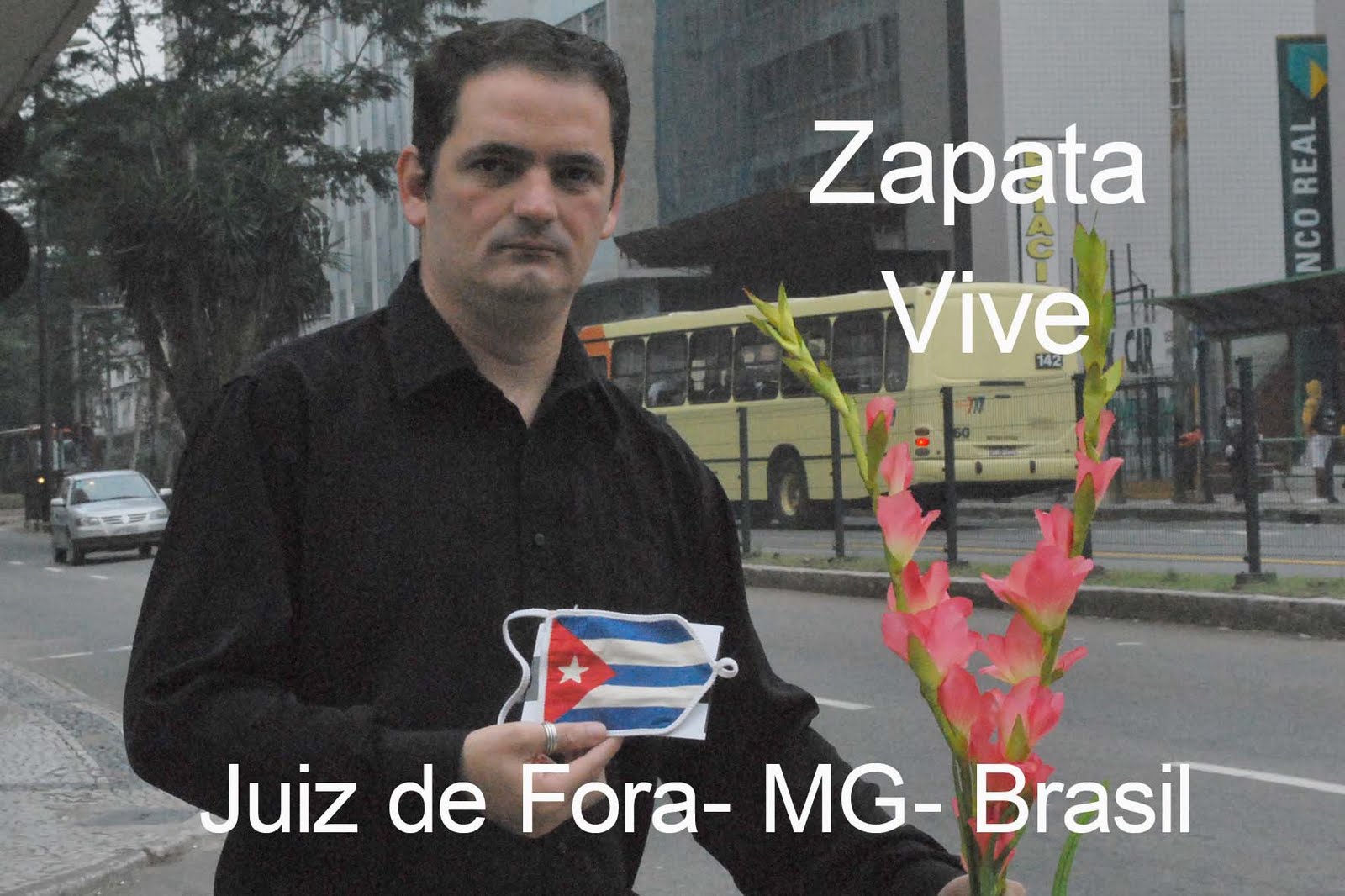


Would you like to be part of this first celebration of Zapata’s birthday? Send us your picture today or not later than tomorrow (May 15th, 2010) with the message “Zapata Vive!” (it can be printed, done by hand, however you want to do it) from anywhere in your city, town or community. Include your name, place where the picture was taken, and your country in the email. Email it to ozt.prensa@gmail.com. It will appear in a post here. Let’s not allow the spirit of freedom of the Cubans to disappear! Zapata lives!

Would you like to be part of this first celebration of Zapata’s birthday? Send us your picture today or not later than tomorrow (May 15th, 2010) with the message “Zapata Vive!” (it can be printed, done by hand, however you want to do it) from anywhere in your city, town or community. Include your name, place where the picture was taken, and your country in the email. Email it to ozt.prensa@gmail.com. It will appear in a post here. Let’s not allow the spirit of freedom of the Cubans to disappear! Zapata lives!


