EU parliament president calls on the Cuban regime to free all political prisoners
posted on Wednesday, September 15, 2010The President of the European Parliament met today [yesterday, 14 September 2010] with recently released Cuban political prisoners: Antonio Díaz, Ricardo González, Normando Hernández and Omar Rodríguez whom are all exiled in Spain.
Following the meeting the President said: "There is no half freedom. Freedom cannot be handed out in small rations. Cuban peoples should enjoy their basic human rights, freedoms and solidarity in their own country, not in exile.
I have the highest respect for these brave people here and their families. They stand as an example to all those who care about freedom, human rights and democracy.
The release of the prisoners is a positive step.
However, the European Parliament calls again for the immediate and unconditional release of all political prisoners in Cuba.
The Cuban government must respect fundamental freedoms, especially the freedom of expression and political association. I wrote this summer to President Castro to allow the Ladies in White (Damas de Blanco) to leave the island so that they can accept Parliament's invitation to collect the 2005 Sakharov Prize in person.
We voice again our profound solidarity with the entire Cuban people and support them in their progress towards democracy and respect and promotion of fundamental freedoms."
Original here.
By María Elena Salinas
For those of us who live in a free society, it’s difficult to imagine what it’s like to survive in a place where expressing your views and asking that your rights as a human being be respected could land you in jail. But that’s what life is like in Cuba. Throughout the years, the communist regime of the Castro brothers has put hundreds of dissidents behind bars.
In a twist of fate, or political maneuvering, 52 prisoners of conscience are being set free, allowed to leave the country with their family members if they so choose. Many of them accepted the offer to begin their exile in Spain.
Among the first nine to arrive in Madrid was Normando Hernandez. He traveled there with his wife and young daughter and was greeted by his mother, Blanca Gonzalez, who traveled to Spain from her own exile in Miami to greet him. I spoke to Normando by phone shortly after. “I feel a lot of sadness and nostalgia,” he told me. “It broke my heart to see my mother crying when she saw the frail condition I am in.”
It was for him a bittersweet moment. Although happy to be a free man and once again reunited with his mother after eight years, it pains him to think of what he left behind. “I left not only family members behind, but also my people, my brothers in the cause who are living their life in slow motion in Cuban jails in deplorable conditions and with the uncertainty of what will become of them.”
When they arrived in Spain, the freed prisoners were taken to a modest hotel in an industrial area in the outskirts of Madrid, where conditions were not quite what one might expect to find in a First World country. No TV sets, the rooms have metal lockers to store clothes, and guests have to share a bathroom. Yet, they could not complain. This was heaven compared with the conditions in a Cuban jail.
Hernandez worked as a writer and independent journalist in Cuba. He was sentenced to 25 years behind bars for reporting on the conditions of state-run services and criticizing the government. According to PEN American Center, a literary and human-rights organization, during his time behind bars he was transferred several times from one prison to another, held in solitary confinement with only four hours of sunlight a week. He was forced to share a tiny cell with insects, rodents and mentally unstable prisoners. He was given polluted water and inadequate food, and was offered only basic medical services. While in captivity, he contracted several illnesses.
The release of the 52 prisoners from Cuban jails is officially the result of the Catholic Church on the island and the government of Spain negotiating with Cuban authorities, but almost certainly was influenced by the bravery of ordinary Cubans who decided to go from oppressed observers to silent protesters, a silence so strong it reverberated in the highest levels of the Cuban hierarchy.
The pressure was on when international public opinion began to shift against the Castro regime as images of the “Ladies in White,” mothers and wives of political prisoners, being harassed by pro-government mobs during their Sunday vigils were broadcast around the world. The death of Cuban dissident Orlando Zapata in February, following an 85-day hunger strike, motivated independent journalist Guillermo Farinas to start his own hunger strike until prisoners who were gravely ill were allowed back home with their families and given proper medical attention. Shortly after the announcement of the release of the political prisoners in Cuba, Farinas, virtually on his deathbed, ended his 130-day hunger strike.
The release of these men is one of the most significant signs coming from the communist island of what could be the appearance of loosening up its tight reign. Critics of the Cuban regime think it’s just a public-relations stunt. The Cuban government has never admitted that there are political prisoners in Cuba, but according to human-rights groups, there are still dozens of prisoners of conscience behind bars.
For his part, Normando Hernandez will begin a new life in Spain, hoping eventually to live his exile in Miami. But his struggle to free Cuba will remain the same: “Whatever it takes to free my people, I will do, as a journalist, as a defender of human rights, in any capacity, but I will do it in a peaceful way.”
The first group of dissidents freed by the Cuban government is set to arrive in Madrid on a scheduled flight on Tuesday, Spanish officials say.
It was still not clear how many would be on the first flight, an official at the Spanish foreign ministry said.
Last week, the Cuban government, the Catholic Church and the visiting Spanish foreign minister agreed a deal to secure the release of 52 dissidents.
Cuba's ex-leader Fidel Castro will be on TV on Monday, official media say.
The official Communist Party newspaper, Granma, said Fidel Castro would appear on television and radio in the evening to discuss his concerns about the Middle East.
Mr Castro has not been seen in public since July 2006 when he had emergency surgery.
Photographs emerged at the weekend showing the 83-year-old former president smiling and greeting workers.
The images were published as the Cuban government began steps to release the first dissidents.
The authorities have gathered several political prisoners and their families at separate locations in Havana.
A Spanish foreign ministry official in Madrid said the first freed prisoners were expected to take a scheduled flight from Cuba on Monday evening.
Over the coming days, 17 freed dissidents are expected in Spain.
On Sunday, a dissident group known as the Ladies in White staged its weekly march calling for the release of their relatives.
Protests continue
There were slightly fewer protesters than usual as some had been taken to a government facility before going to the airport to join their husbands on a flight to Spain.
The prisoner release, which could become the biggest this decade on the communist-ruled island, was announced last Wednesday.
Under the agreement, 52 political prisoners will eventually be freed.
All were part of a group of 75 dissidents rounded up in 2003 and sentenced to jail terms of between six and 28 years.
Leader of the Ladies in White Laura Pollan said their marches would continue.
"While there is one political prisoner or prisoner of conscience, there will be Ladies in White," said Ms Pollan.
"This is what we pledged from the beginning and the Ladies will keep that promise."
Cuba has always denied that it has political prisoners, calling them mercenaries paid by the US to undermine Havana's rule.
Spain's ABC newspaper: Laura Pollán: "As long as there is one political prisoner and of conscience, there will be Ladies in White"
posted on Sunday, July 11, 2010Laura Pollán, spokesperson for the women’s group told journalists that “as long as there is one political prisoner and of conscience, there will be Ladies in White. That was our promise from the beginning, and we the Ladies will keep that word.”
Some 40 wives, mothers and other relatives [of the political prisoners] attended Mass at the [Catholic] Church of Saint Rita de Cassia, in La Habana. Later, they marched, and then prayed kneeling in front of the temple as a thanksgiving for the release of the political prisoners.
Regarding the current situation of some of the 52 [remaining] prisoners whose release and trip to Spain alongside their relatives has been announced by the Catholic Church this week, Pollán stated that 20 out of the 26 asked yesterday, are willing to leave the country, and six “have stated that no, that they will stay in their motherland.”
According to Pollán, this morning, they telephoned some of the prisoners that have been transferred to the Combinado del Este prison (in La Habana) where there are already 11 (of the ones slotted to travel to Spain), and were told that some of their relatives are at a military institute near the “Valle Grande” prison doing travel paperwork.
“This is real, and it feels us with hope because at least half are already being processed [to travel], [but] I cannot say what will happen with the last (prisoner).”
Among the political prisoners asked [about their willingness to leave the country] are Jesús Mustafá, from Santiago de Cuba, José Daniel Ferrer, Pedro Argüelles, Regis Iglesias, Eduardo díaz Fleitas and Arnaldo Ramos
The Ladies in White’s leader stated that she does not know “what will happen with them, if they will be imprisoned until the last minute or will be released in the upcoming days, but at least we have the hope that they are all going to be freed.”
Regarding the legal status of the released prisoners, Pollán said that “neither the Church, nor the government have said anything to us, we cannot say (…) if it is a [forced] exile for them, although it has been said that their relatives can return, and they will be able to preserve their properties.”
The government of Raúl Castro has promised to free gradually, and in a four-month long timeframe to release 52 political prisoners, within the context of a dialog opened with the Catholic Church hierarchy in the island, a process supported by Spain that will receive all the [prisoners] from this group that wish to travel to that country.
These 52 oppositionists are the ones that remain in prison from the “Group of 75” that were sentenced to [anywhere] between 6 and 28 years [in prison].”
The Cuban Catholic Church said on Saturday that out of those 52, it will be 17 the first ones to be freed, and travel to Spain.
On that topic, Pollán said that the Archbishop of La Habana, the principal interlocutor in the dialog between the Church and the government, has not spoken to the Ladies since 2 July.
However, she said that the group “has some questions, and it would be interesting” to be able to speak with him so that he can transmit them to the government and they can be answered.
In Pollán’s opinión, what has happened until now “is a good beginning” that “windows are being opened” and their only request is that after their relatives are released “they don’t put others in [jail].”
This article appeared originally in Spanish. This is our translation.
Fariñas will restart hunger strike if regime does not keep its promise
posted on Friday, July 09, 2010It came as the Catholic church announced five dissident’s would soon be freed and allowed to go to Spain. Despite that a weak and bedridden Farinas wrote a letter declaring his intentions.
Speaking on behalf of Farinas, dissident Hector Palacios said: "I (Fariñas) will recommence my hunger and thirst strike if what has been agreed does not take place. If what has been agreed happens then there is no need to continue this protest."
Farinas stopped eating and drinking in February after the death of prisoner Orlando Zapata.
A wife of one jailed dissident said: "This act of Farinas, together with the hunger strike and death of Zapata, and all the repression suffered by the ‘[Ladies] in White’ has made the world suffer and has forced the government to free our family members from jail."
More, including video at the link above.
It was not Orlando Zapata Tamayo’s name, however, what the headlines highlighted yesterday, after the announcement of the release, but the “mediation of the Church,” and the visit of Spain’s Foreign Minister, Miguel Angel Moratinos, to the island. Without trying to diminish their roles in this process, it is necessary to remember that Spain’s policies toward Cuba have not changed at all during the past several years. Neither have changed the positions and attitudes of the Cuban top hierarchs of the Roman Catholic Church, nor, for that matter, those of the regime itself that keeps in place a draconian, illegitimate and arbitrary penal code that allows the imprisonment of Cubans for their opinions. The only truly new element with any political repercussion this year within the Cuban reality has been Orlando Zapata Tamayo’s death on February 23rd, with the intense wave of solidarity with our political prisoners and of strong condemnation of the Castro regime that it generated. It is impossible to forget and to allow that this fact be hidden from the world’s view.
Zapata’s sacrifice inspired Guillermo Fariñas’ hunger strike, gave new meaning to the marches of the Ladies in White, and moved the European Union and other democratic governments and parliaments to condemn the Cuban regime. It united, reactivated and renewed the internal opposition. It mobilized thousands of Cuban exiles who organized marches and protests for their country’s freedom around the world. It generated intense campaigns of local or global reach, like our own #OZT: I accuse the Cuban government, where dozens of thousands of people from more than a hundred countries and from all over the political and ideological spectrum, including distinguished personalities, have openly demanded the release of all Cuban political prisoners, and respect for human rights in Cuba.
The unity of the Cuban democrats around a common purpose and the firm and consistent support of the international community for the release of the political prisoners and the respect for human rights in Cuba have been the decisive factors leading to the releases announced yesterday. The actual reach and nature of these releases will also depend on our ability to preserve and reinforce that unity, and the solidarity from civil societies and democratic governments from around the world.
The forced exile of imprisoned opponents, just as it has been announced by the Spanish Foreign Minister, is a clear step backward in “the transition process toward a pluralist democracy and respect for human rights and basic liberties” established as a main objective on the European Union’s Common Position on Cuba. This massive banishment of opposition activists will deprive the transition of their main actors. Only a release without banishment, accomplished without fanfare, and with firm guarantees to exercise and defend human rights, would merit a reassessment of the Common Position or any other significant change on policy by any democratic government toward Cuba.
Our campaign strongly condemns and rejects the link established between the release of political prisoners and their forced exile, the bait and switch deal offered to the Cuban democratic movement, a ploy for which we will not fall. We also demand that the releases include all Cuban political prisoners, all those imprisoned in Cuba for their peaceful opposition to the Cuban regime or simply for exercising their inalienable rights: freedom of press, of expression, of gathering, of association and of movement, systematically violated and punished by the practices and laws of the Cuban dictatorship. As long as this is not accomplished, our campaign is going to continue.
The invitation to sign the Declaration of #OZT is still open to all. Our first delivery of the signatures will occur without delay on July 23rd, 2010.
75 Ladies in White and Ariel Sigler Amaya march together in La Habana
posted on Sunday, June 20, 2010“Here are all the wives of political prisoners from [the provinces] of Pinar del Río, Matanzas, and the great majority of the ones from Oriente y Villa Clara" said Berta Soler, a leader of the group.
There were 5 children among the ladies. They are the children of political prisoners.
Seventy five of the Ladies in White in attendance, marched on Quinta Avenida [Fifth Avenue] in the Miramar neighborhood of La Habana, as they have done for the past seven years. The other five could not march due to their advanced age.
Reina Luisa Tamayo, mother of Orlando Zapata Tamayo and a Lady in White herself, was at the church, and later joined the march.
Marching with the Ladies, albeit in a wheelchair to which he has been confined due to his seriously deteriorated health, was recently released political prisoner Ariel Sigler Amaya.


“The recent transfers of 12 prisoners have helped their families, but we fight for their release, for their return to their houses, to their homes, because they are innocent”, said Laura Pollán, wife of imprisoned journalist Héctor Maseda.
“We will continue the struggle until they are all released from prison” stated Pollán.
Hat tip and photos, Marc Masferrer
Payá: “The Church should act as a facilitator of the dialogue amongst the parts”
posted on Saturday, June 19, 2010Cuban opposer Oswaldo Payá, Coordinator of the Movimiento Cristiano Liberación and leader of the Varela Project, denounced today [Thursday, 6/17/10] from Havana that the process of negotiation between the Catholic hierarchy in the island and the Cuban government is excluding the dissidents and said that the Church should act as a “facilitator” of the dialogue amongst all the parts.
In a communiqué released today [Thursday, 6/17/10], Payá also accused the Spanish government of having “accepted the rules of the Cuban government” in its role as interlocutor between the European Union and Cuba, and particularly that the “highest representatives of the Spanish government do not engage in dialogue with the peaceful Cuban dissidence.”
“We believe that Cubans should not be relegated to spectators of this or any other negotiation or dialogue, but must be ready to be protagonists of their liberation,” says the 2002 winner of the Sarajov Award, granted by the European Parliament, after pointing that “nobody must pretend to be a political actor from the Church, because that turns the church into a political entity” instead of a “facilitator of the dialogue.”
Aranguren denies the exclusion
The Bishop of the Cuban province of Holguín, Emilio Aranguren, denied that the Catholic Church has an intention to exclude, although he mentioned that he wasn’t aware of the text written by Payá, reported EFE.
“I don’t think that in any moment the Cuban bishops have that sense of exclusion,” said, at a press conference in Havana, Aranguren, who is also a member of the Permanent Committee of the Conference of Catholic Bishops in Cuba.
Aranguren referred to this matter when answering questions from journalists at a press conference in Havana celebrating the X Social Week of Church in Cuba, which was inaugurated yesterday [Wednesday, 6/16/10] by the Vatican Secretary of Foreign Relations, Dominique Mamberti.
Mamberti will not meet with dissidents
The Foreign Secretary of the Vatican, Archbishop Dominique Mamberti, will not meet with Cuban dissidents or with the relatives of political prisoner during his official visit to the island, which will go on until Sunday, reported Europa Press (in Spanish).
The Ladies in White, and organization formed by wives and relatives of prisoners of conscience, were also left aside of the meetings scheduled by the Archbishop, in spite of the fact that these women consider themselves practicing Catholic and have managed to continue their traditional peaceful walks in Havana thanks to the support of the clergy.
Both the hierarchy of Cuban Catholic church and the authorities in the island have insisted in unlinking the visit of Mamberti with the dialogue initiated a month ago with the outcome, for the moment, of a “license” for the conditional release of an extremely ill Ariel Sigler Amaya, and the transfer to jails closer to their homes of 12 political prisoners.
US National Public Radio reports on some of the latest developments in Cuba
posted on Wednesday, June 16, 2010OUR OPINION: Another round of harassment of dissidents
Once again Cuba's 51-year-old regime gives with one hand and takes away with another - even as the European Union is poised to discuss the potential for strengthening economic ties with the communist island.
After the Cuban dictatorship, under international pressure, seemed to be considering moving 26 sick political prisoners to hospitals a couple of weeks ago, officials cracked down again. Last week, they detained 37 dissidents for several hours to prevent them from attending meetings to discuss Cuba's political and economic crisis.
Despite the harassment, dozens of dissidents managed to attend the meetings and voted in solidarity with the Ladies in White, the Cuban women who peacefully march in Havana to call attention to their loved ones' imprisonment. They also discussed the international attention that the February death of hunger-striking dissident Orlando Zapata Tamayo sparked.
Prisoners are ailing
Leaders of Cuba's Catholic Church have been in talks with Raúl Castro in an effort to help the 26 ailing prisoners, among 75 who were swept up in 2003 in another crackdown in which the regime accused the dissidents of being U.S. ``mercenaries.'' Back then, there appeared to be another opening on the horizon, too, as Fidel Castro put on his ``charm'' offensive in an effort to sway Republicans in farm-belt states to press the Bush administration to drop the U.S. embargo of Cuba.
Which raises the perennial question: Do the Castros really want trade and diplomatic relations to improve with the United States and the European Union?
It sure doesn't seem like it.
Even as the regime has moved a few dissidents to prisons closer to their homes, it has continued to harass, detain or arrest others. Meantime, another dissident, Guillermo Fariñas, has caught the world's attention with a hunger strike.
Cuba undercuts progress
Spain, under Prime Minister José Luis Rodríguez Zapatero's socialist government, has been pressing the European Union to embrace the Cuban regime without using human rights as a condition for more-favorable trade agreements. But with the recent harassment of -- and regime-backed mob violence directed at -- the Ladies in White, the detention of dissidents and Cuba's snail's-pace response to treating the ailing political prisoners, that's unlikely.
The EU's ``common position,'' established 14 years ago by Spain's then-Prime Minister José María Aznar, sought more direct contact with dissidents to nudge Cuba toward democracy. That is seen as a ``unilateral'' strategy by the Zapatero government, which has proposed more talks with Cuba in a ``bilateral'' stance.
Problem is, Cuba's government has shown through its actions that it does not give any consideration to human rights, even when it claims to be in agreement with the United Nations' universal declaration on human rights. That's why it's welcome that the U.S. State Department is poised to release $15 million to international human-rights groups working in Cuba.
The EU, urged by Spain two years ago, lifted sanctions it imposed after Cuba's 2003 crackdown. Now it's Cuba's turn to act, but so far its actions speak loudly of the same old intransigence.
Marc Masferrer: 3 Cuban political prisoners transferred to 'work camps'
posted on Monday, June 07, 2010An arrangement between the Castro dictatorship and the Cuban Catholic Church last week led to the transfer of three political prisoners to "work camps" in their respective home provinces
• Dr. José Luis García Paneque, 45, was moved to a camp dubbed "Plan Confianza" in Las Tunas province.
• Iván Adolfo Hernández Carrillo, 39, was transferred to a "Plan Confianza" camp in Matanzas province.
• Félix Navarro Rodríguez, 56, was moved to the San Agustín camp, also in Matanzas.
As for the other three prisoners reportedly transferred, Diosdado González Marrero, 47, and Antonio Díaz Sánchez, 48, were transferred to the Agüica maximum security prison in Matanzas; and Arnaldo Ramos Lauzurique, 68, was moved to the 1580 prison in Havana.
All six prisoners have been in jail since the "black spring" of 2003.
According to an EFE news report posted on the Asociación Damas de Blanco website, the work camps have less severe security regimens, the food is better and prisoners have better communication with their families.
However, remember this: The work camps, as well as the Agüica and 1580 prisons, are still part of the Castro gulag, and these men are still prisoners of conscience. No promises have been made and when it comes to the dictatorship and the church, we should be skeptical of any promises made.
But hopefully the transfers are the precursors for a more permanent solution — their unconditional release — for these heroes and their families
Repression increases in Cuba amidst negotiations between the regime and the Church
posted on Friday, June 04, 2010Thirty seven dissidents were arrested in Havana between Thursday and Friday as part of a raid from the Cuban political police to avoid the celebration of two important meetings, declared opposition leader Héctor Palacios.
On Thursday, the police tried to prevent the meeting of the Committee for the Transition and arrested 14 people; while on Friday there was a similar raid against the meeting for the annual assembly of the Unidad Liberal de la República de Cuba (ULRC) [Liberal Unity of the Cuban Republic] that was to take place in the house of
opposition member Héctor Palacios. 23 dissidents were arrested.
Those arrested on Friday, the political police has taken them to different police stations throughout Havana, according to the Comisión Cubana de Derechos Humanos y Reconciliación Nacional [Cuban Commission for Human Rights and National Reconciliation]. The whereabouts of some of the arrested is unknown.
The meeting of the ULRC took place with the attendance of 18 dissidents who managed to enter Palacios’ house before dawn.
Gisela Delgado, member of the Ladies in White, denounced the arrests of several dissidents in Holguín and Guantánamo, who were prevented from traveling to the capitol of the country.
The spokesperson for Guillermo Fariñas, Lisset Zamora, is still under arrest, along with other colleagues from the central Cuban province of Villa Clara, confirmed Palacios to DIARIO DE CUBA (Cuba Daily).
'Fariñas cannot wait five weeks'
Héctor Palacios, president of Unidad Liberal de la República de Cuba told Diario de Cuba that Guillermo Fariñas, in hunger and thirst strike since 101 days, “cannot wait five weeks, because he will not be able to sustain it.”
“At the rate the negotiation between the Catholic Church and the government is going, I believe that Fariñas will die. We must raise our voices so that that doesn’t happen,” said Palacios.
Also, he confirmed that opposition member Félix Bonne, who attended the meetings on Thursday and Friday, reiterated his disposition to go on a hunger strike if Fariñas dies.
Unidad Liberal analized the situation of Fariñas’ health, the subject of political prisoners and the solidarity with the Ladies in White and Ladies in Support [of the Ladies in White]. About the latter the say that “solidarity cannot be limited” and encourage them to continue their peaceful walks.
This new repressive act comes in the middle of an uncertain negotiation between the regime and the Catholic Church to “improve” the conditions of the political prisoners.
(Source: Diario de Cuba).
From my position as Western [region of Cuba] Coordinator and member of the national executive board of Partido Cuba Independiente y Democrática [Independent and Democratic Cuba Party] (CID), I call on all Cuban women who identify themselves with the cause of the liberation of all political prisoners, to support the marches and other acts organized by the Ladies in White.
These women have valiantly come together since March of 2003 to the demand from the highest authorities of the Cuban government the immediate and unconditional release of all their relatives (sentenced to 20 years and more in rigged summary trials). To this end, they have exhausted numerous resources: letters to all established legislative institutions, to the highest government authorities including ex president Fidel Castro, the highest authorities of the Catholic Church in Cuba, to the Cuban Conference of Catholic Bishops, the Holy See’s Apostolic Nuncio, to Their Holiness popes John Paul II and Benedict XVI, several heads of state that have visited the island. They have collected signatures, participated uninterruptedly in the Eucharistic Mystery at Santa Rita Catholic Church in Havana’s neighborhood of Miramar. They have conducted weekly Sunday marches on important thoroughfares of the city, with which the Cuban people has identify, carrying a gladiolus as their only weapon that has been given in many cases to the people who have spontaneously requested it. In return, they have received “acts of repudiation” and beatings by paramilitary mobs directed and organized by Security of State.
Today the government, the political police, and the Cardinal Archbishop of La Habana, His Most Reverend Excellency Monsignor ++Jaime Lucas Ortega y Alamino, have requested the retreat of the support group to the Ladies in White, looking to weaken the marches and demands for the release of all prisoners of conscience. We reject this action, and support these Cuban women who defend their legitimate right of freedom for their love ones, as in her time it was understood and exercised by the mother of Fidel and Raúl Castro, back then dressed in all black.
Cuban woman, tomorrow can be too late. Our example lies in the premeditated and avoidable death of Prisoner of Conscience Orlando Zapata Tamayo. Join in this demand for the freedom of all political prisoners which is also for Cuba.
Katia Sonia Martín Vélez
CID Coordinator for the West
Nine days have passed since it was announced to The Ladies in White that a transfer to hospitals of The 26 gravely ill political prisoners was imminent.
One hundred days since Guillermo Fariñas initiated a hunger strike for the liberation of The 26.
Eleven days have gone by since authorities at the penal camp in a remote region of Villa Clara, told Silvia Aguado, the wife of political prisoner Antonio Villarreal that they would transfer her husband to a mental health facility to receive the treatment he needs.
Eight days have elapsed since Silvia Aguado saw her husband wasting away under a tree at the same penal camp.
One day since the Ladies in White denounced that despite all promises to the Church, the regime has not taken any real steps to improve the conditions of any political prisoners.
One hundred and one days since Orlando Zapata Tamayo died in a hunger strike demanding the release of The 26.
Ninety-six days since we launched #OZT I Accuse the Cuban government and signatures in support of the release of all Cuban political prisoners started to pour from all over the world, including Cuba.
We are counting every second that passes while the regime refuses to accept the demands of thousands around the world, and in Cuba, to release all Cuban political prisoners immediately and unconditionally.
We hold the regime responsible for the further deterioration in the health of any political prisoner caused by the terrible and inhumane conditions in which they are kept, and the torture and abuse by the regime’s henchmen.
We will not stop demanding the release of all Cuban political prisoners until this is achieved.
McClatchy News: Castro's meeting with Catholic church greeted with hope, skepticism
posted on Tuesday, May 25, 2010Juan Tamayo with The Miami Herald Reports:
"Raul Castro's talks with the Catholic church on political prisoners have sparked hopes, skepticism and assertions he's taking a risk by recognizing the church as a mediator in Cuban affairs.The meetings with Cardinal Jaime Ortega are the first time in memory the communist government has negotiated with a national and independent organization like the Cuban church, in an island where authorities at least try to control virtually all activity.
They also represent Castro's most important political shift since he succeeded his ailing brother Fidel two years ago, a change that has given added weight to a church tightly limited throughout most of the last five decades.
While the local church has long decried the country's many problems, ‘what is new is the government's readiness to publicly recognize the Cuban catholic church as a middleman for resolving key issues,’ Havana dissident Oscar Espinosa Chepe wrote in a column Monday.
Fidel Castro freed 3,600 political prisoners after 1978 negotiations with exiles, and about 300 dissidents and common criminals after Pope John Paul II's 1998 visit to Cuba. He also released a few to visitors like The Rev. Jesse Jackson and New Mexico Gov. Bill Richardson.
Now his brother's meetings with Ortega have raised hopes for an improvement in Cuba's human rights record, as well as complaints the cardinal is being manipulated by Raul Castro to give a propaganda boost to what may be meager changes on the political prisoners.
Castro has promised to move some political prisoners in poor health to hospitals, move other jailed dissidents to institutions closer to their homes and eventually released some of Cuba's estimated 190 prisoners of conscience.
Some analysts are cautioning, however, that Castro is taking a risk that his talks with Ortega may embolden dissidents, average Cubans and even government officials critical of his slow pace in adopting desperately needed economic reforms.
‘The government is tacitly recognizing with this gesture that it will definitively accept the risks of thinking differently,'' said Julio Hernandez, a Miami supporter of dissident Oswaldo Pay's Christian Liberation Movement.
‘This means the church has won a big space of trust,’ added Hernandez. ‘The opposition and the dissidence now must be sensitive to that and adopt a path for peaceful proposals.’
‘When the authorities recognize any sort of independent source of power, they are admitting a weakness,’ said a Havana author who asked to remain anonymous to avoid possible retaliations for his comment.Phil Peters, a Cuba analyst at the Lexington Institute think tank in suburban Washington, noted that Havana in the past has gone over the heads of the local church officials and negotiated directly with the Vatican on issues such as permissions to open new seminaries.
The Castro-Ortega talks, he added, ‘mark the government accepting the church as a part of civil society ... I don't particularly see any risk (for Castro) in it, but it is opening up a new space for political discussions on topics that were not open before.’
Retired CIA Cuba expert Brian Latell noted that the church-state talks come at a time when Castro faces a crushing economic crisis as well as a wave of international condemnations of his human rights record.
They include the Feb. 22 death of jailed dissident Orlando Zapata after a lengthy hunger strike and a crackdown on the Ladies in White protesters earlier this year.
‘This represents a reflection of how much pressure they (the government) are feeling for the human rights, and pressures from a whole array of domestic problems,’ Latell said. ‘They're hoping the cardinal can help to alleviate some of those pressures.’
But he added that he did not foresee any risk to Raul Castro because Ortega was unlikely to push too hard during the conversations with Castro. ‘I don't see him turning the screws hard on Raul.’
Espinosa Chepe, one of the 75 dissidents jailed in the 2003 roundup known as the Black Spring but freed for health reasons, said Castro's readiness to ease conditions for political prisoners could help improve Cuba's relations with Washington and the European Union.
‘It's clear that President (Barack) Obama favors better relations with Cuba ... but he has been blocked by the lack of reciprocity,’ he wrote. If some political prisoners are freed, ‘that could make it easier for the administration to take additional steps.’
In Washington, a State Department spokesperson said, ‘We've seen the optimist prognosis (for the political prisoners) and are looking forward to seeing what concrete steps the Cuban government will take. We have urged the Cuban government before to release its prisoners of conscience.’
The Washington-based Center for Democracy in the Americas, which favors easing U.S. sanctions on Cuba, issued a statement saying that the Castro-Ortega talks were ‘a real lesson for U.S. policy makers. Talking to the Cubans, not using sanctions ... is the most effective way to achieve progress.’
Oscar Peua, director of the Miami-based Cuban Commission for Human Rights, complained in a blog post that Raul Castro had ‘jumped over the heads of the dissidence’ in order to negotiate with Ortega.
‘But since the key issue is the release of all political prisoners, we do not hold back in being grateful’ Peua added, even though it does not ‘resolve the sad reality of misery and lack of freedom that Cubans suffer for more than half a century.'"

Orlando Márquez, director of the [Archdiocese of Havana’s] magazine Palabra Nueva [New Word] and of media relations for the Archdiocese of Havana stated today that there is no established date to begin the movement of political prisoners to their provinces as agreed by the regime. “It has never been said that the transfers would begin on Monday. What was said is that the negotiations about those transfers will begin this week” he said over the phone to members of this campaign.
Márquez also said that before the government’s promise was known, “there had been some political prisoners already transfer to hospitals.” For more details, Márquez refers all interested on the topic to data shared by Cardinal Jaime Ortega during his press conference last Thursday 20 May 2010.
Aside from that, he stated that the meeting between Raúl Castro and Jaime Ortega was “at the request of the Church.”
Ladies in White are hopeful

At the same time, she explained that political prisoner Manuel Ubals was transferred to his native Guantánamo. “They tolds us in the meeting at the Archdiocese that this is like a set of stairs, and that we cannot just jump over all the steps at once. We will proceed step by step, and that is why we have so much faith, [and] we are so hopeful that there will be good news.”
Pollán, the wife of independent journalist Héctor Maceda Gutiérrez, sentenced to 20 years during Cuba’s Black Spring along with 74 other opposition activists, added: “What is clear is that these will be staggered steps. We cannot think that they [the regime] will open the jail bars immediately, and that all will be released at simultaneously, no, it will be in a step by staggered fashion: we don’t know how much we will be able to climb, and how it will take between steps.”
“If we think about it, in seven years—she added—the prisoners have been release on a yearly average of three [prisoners per year], there have only been 21 of them released because Reynaldo Labrada served [the whole sentence]. Anything they [the regime] do at this time is very important. There have been talks about [transfers to nearer facilities], [although] we don’t know when this will happen because we were not informed. However, until now, the government has never said when they will do things. We have found out that the prisoner is freed when Security of State comes looking for a relative or when he is brought home.”
“But I think it is very important that those more gravely ill are released, as well as transferring those who are far away. We must continue [to be] united. With unity we can achieve little by little the liberation of the political prisoners. And we, as the relatives, the sisters to those men, are the ones called to continue on this struggle.”
Laura Pollán reiterated, as a conclusion: “Know that there will be Ladies in White on the streets as long as there are political prisoners in Cuba.”
Press release of the “#OZT: I Accuse the Cuban Government” campaign regarding the mediation of the Catholic Church in the release of Cuban political prisoners.
The mediation of the Church
The recent dialogue between the high hierarchy of the Catholic Church and the Cuban government regarding the release of the political prisoners is a promising event. We are in favor of negotiations to achieve this goal which is the fundamental reason of being of our campaign.
We also celebrate the strengthening of the mediating capacity of the Church, as long as it does not assume the role of the parties it intends to mediate for. The negotiation is not between the Church and the government, but between the government and the pro-democracy sector of the Cuban population, which has been systematically repressed by the regime.
The willingness of the government to dialogue with the Church comes out of a specific context, which is impossible to conceal. This dialogue has arrived after the supreme sacrifice of Orlando Zapata Tamayo, the hunger and thirst strike of Guillermo Fariñas, the marches of the Ladies in White and the Ladies in Support, the effective unity among the opposition, the exile, the Cuban civil society and the international community who joined for a fair demand the release of political prisoners and the respect of human rights in Cuba. Any release that presupposes the fracture of that unity on those factors goes against the interest of those who remain in prison.
Our commitment is with the 26 political prisoners for whom Guillermno Fariñas is carrying his hunger strike as well as with the victims of the Black Spring. But not only with them. Our goal is to not go back to the situation of Cuba in March 2003. The “#OZT: I Accuse the Cuban Government” campaign will last as long as there are political prisoners in Cuba and its citizens are denied the exercise of human rights.
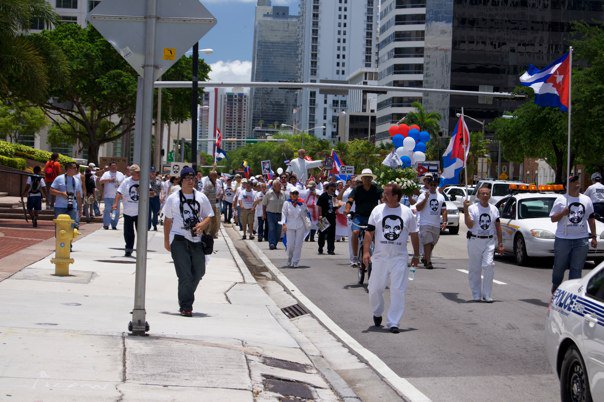
Here are some images and video of the different marches that happened for Cuba's freedom yesterday:
Milano, Italy:

Santiago de Chile, where there is no more fear:
Tampa, Florida, USA:

Las Palmas, Gran Canaria, Spain

Miami, Florida, USA: